
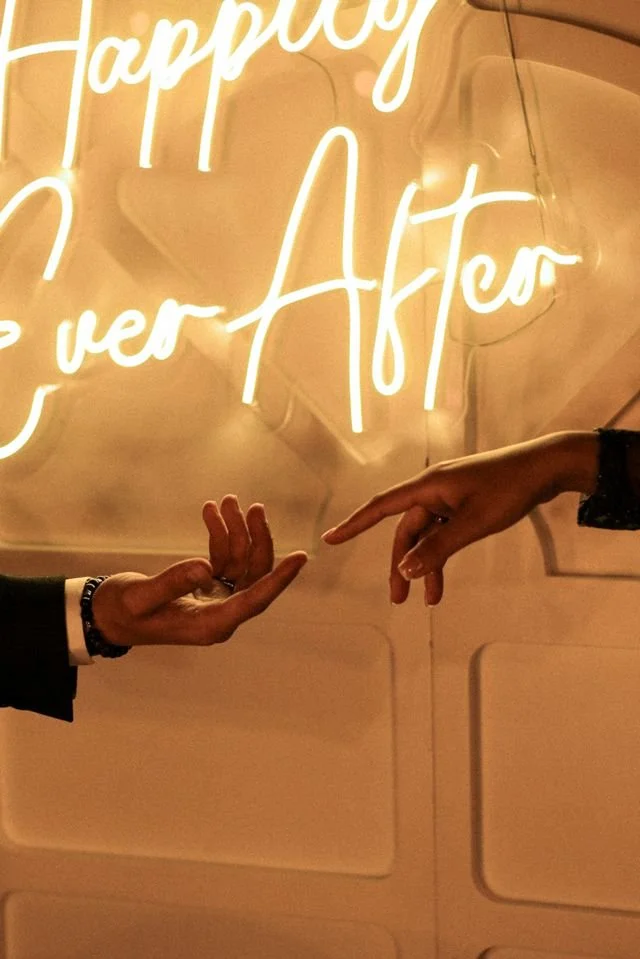
Happily-ever-after! Is there a problem with that?
What are your relationship expectations? It’s important to examine them, because dealing with another person means you have to negotiate your differences. The only person you’ll see eye to eye with is your reflection in the mirror! How do you see relationships?
I want to be loved unconditionally
You may be hoping to find someone to love and take care of you, perhaps in the ways you wish your parents had done, someone who will make you feel safe and protected. Someone who will give you the unconditional love you’ve always craved. It’s an absolutely understandable wish.
The problem is that unconditional love is a fantasy. You’re approaching another adult from a childlike place, with your unmet childhood needs front and center. The not-great news is that a person who is eager to meet your unmet childhood needs is offering to be a parent, instead of a partner, and sees you as a child, instead of as a fellow adult, though both of you may be unaware of your respective motivations.
I want to be swept off my feet
Or you may imagine that when you meet “your person,” you’ll have butterflies in your stomach and you’ll instantly know that he or she is “the one.”
In this example, you confuse fantasy with reality, expecting someone to sweep you off your feet, rather than to be a real person whom you get to know over time. There’s no shortcut to a viable relationship. There’s no two-week equivalent of a five-year relationship, just as there’s no two-week equivalent of a five-year friendship.
Happily-ever-after is a Disney construct that implies no bumps in the road, no difficulties, no learning to compromise. We never see Sleeping Beauty and the Prince five years into their marriage, when they need to figure out household tasks, childcare, budgeting, holidays with families, etc. We never see real life, just a fantasy of perfection.
And let’s deconstruct the idea of finding “the one.” Is there really only one person in the entire world you could be happy with and that could be happy with you? That would mean that if your partner dies, you’re fated to live the rest of your life alone, because your partner was your one shot at love.
I know a lovely couple who were both previously married to people they deeply loved. Their first spouses died prematurely. These two widowed people later met and now have been married over thirty years. They have made a very satisfying life together, but not without its difficulties. After all, this is life, not fantasy! But they consider themselves very lucky to have had two satisfying marriages, the second of which never would’ve happened if they had bought into the idea—the fantasy—of “the one.”
I want to have a fabulous life with a fabulous spouse
Or you may look at your friends who “married up” financially and hope to do the same, especially when you see the luxe vacations and other details of their fabulous lives posted on Instagram.
However, the idea of “marrying up” implies that people are arranged in some sort of rank order and that relationships are about getting, rather than loving. That approach comes with its own considerable set of problems.
What’s the role of a relationship in a satisfying life?
After reading this, you may believe that I am cynical about love. Nothing could be further from the truth! I’m absolutely on the side of love and on the side of reality, instead of fantasy. And when you take the time to work on yourself, learn who you are, and know how to make yourself happy, you may decide that this is the kind of life you want to continue on your own, a totally valid choice. Or you may decide to partner with someone else who is also in reality, knows who s/he is, has worked on him/herself, knows how to make him/herself happy, and make a fun time together.
There’s not one choice that’s better than all others. There’s not the one choice that means you’re a successful human being. As one of my wise mentors says, “The best relationship is one in which either person can leave at any time, which you means you’re there because you want to be there—not out of dependency.”
If you’re struggling with understanding your relationship to relationships, if you’re having a difficult time in a relationship, read about couples counseling and marriage counseling and give me a call or use the contact form. I’m here to help.